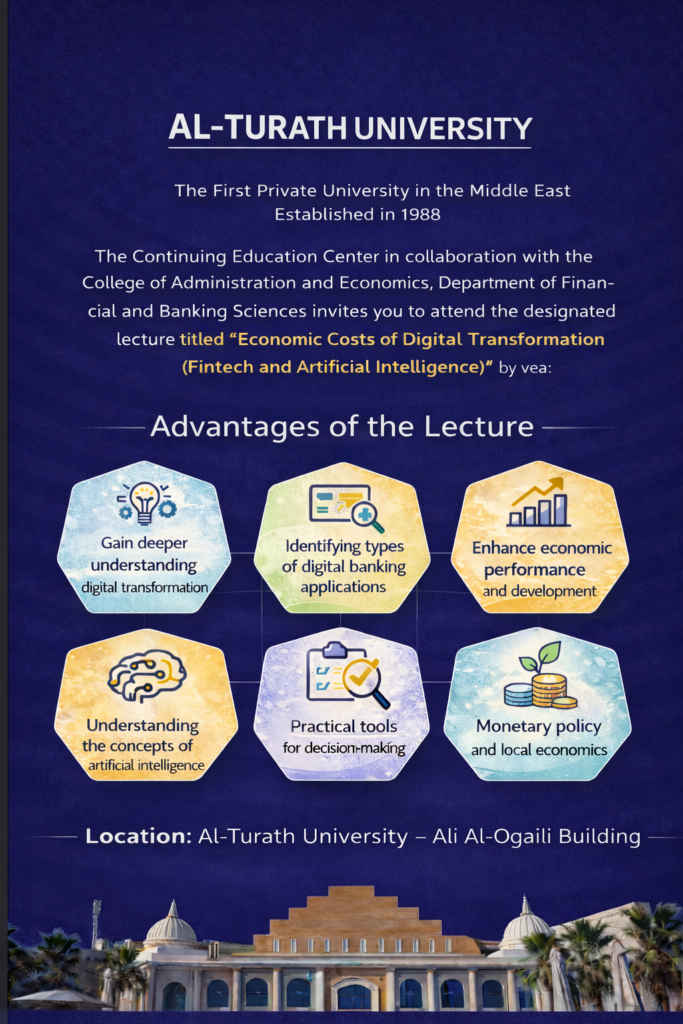

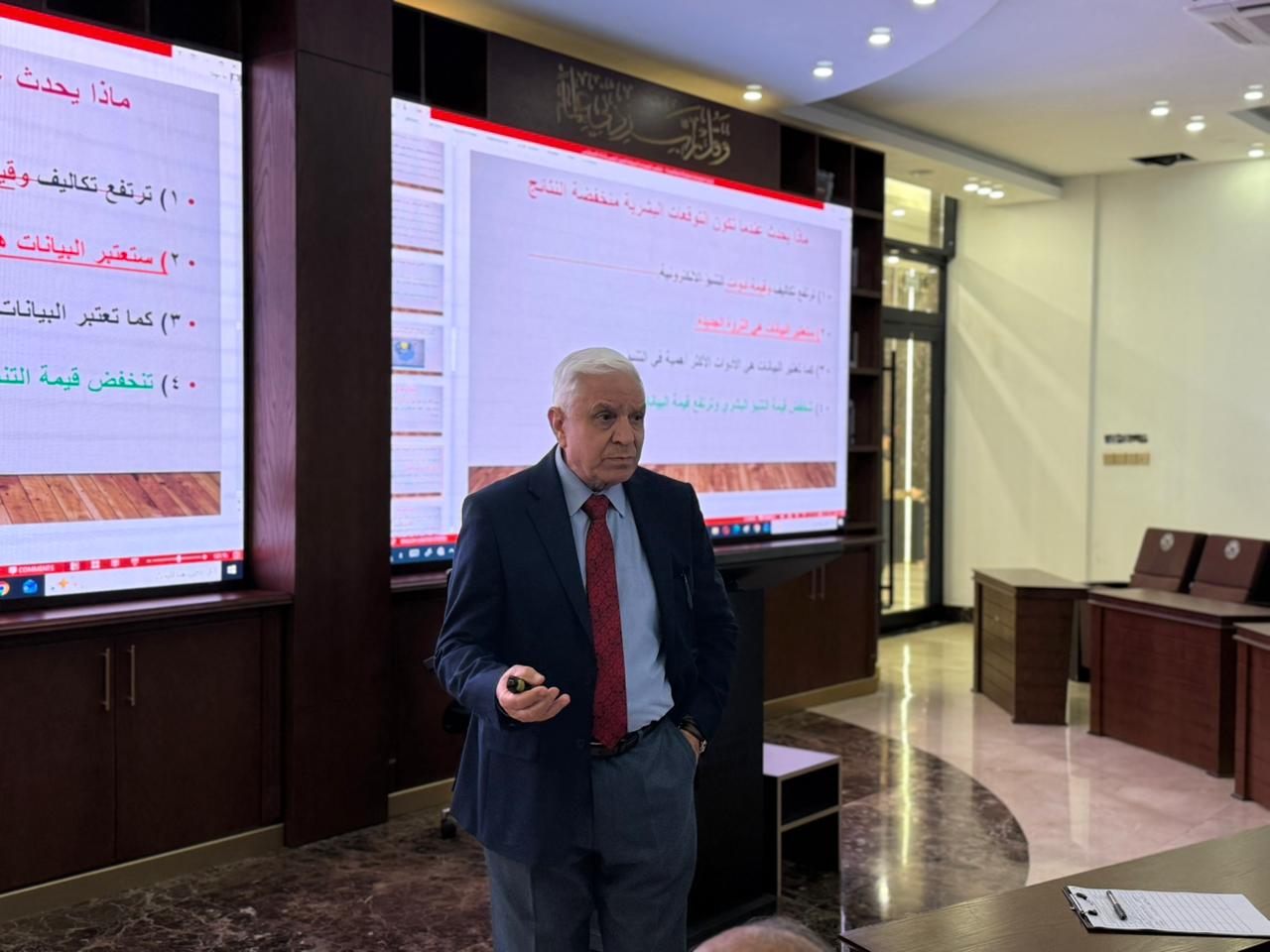
Al-Turath University presented an analytical perspective that views digital transformation and artificial intelligence as matters of economic calculation and strategic decision-making rather than mere technological advancement, the Continuing Education Center, in cooperation with the Department of Financial and Banking Sciences, organized a scientific lecture entitled (The Expected Economic Costs of Digital Transformation and Artificial Intelligence) placing the question of cost at the center of discussion and linking it to the capacity of institutions and societies to manage transition with awareness and preparedness.
The lecture was delivered by Assistant Professor Qais Abbas Hassan, who addressed the growing applications of automation across various professions and highlighted the significant percentages it has reached within modern work environments, as well as reviewing that transformation does not merely redistribute tools but reshapes the map of professions themselves, as some occupations decline while new ones emerge according to evolve patterns of demand for skills and knowledge.
The lecture provided direct academic value by enabling participants to understand the cost of implementing artificial intelligence, identify the types of expected costs, and enhance economic comprehension of digital transformation, as well as highlighting practical decision-making models, analyzed return on investment, and discussed the national dimension and macroeconomic impact, ensuring that the technological debate remained connected to real economic consequences for institutions, markets, and society.
Al-Turath University demonstrated that the contributions of a number of interested faculty members from different scientific departments added analytical depth to the discussion, reinforcing the importance of academic dialogue when it moves beyond theory to applied interpretation and strategic foresight.
The participation of students from the Department of Financial and Banking Sciences further strengthened the educational dimension of the lecture by linking academic specialization with labor market realities and highlighting the necessity of building future-oriented skills capable of responding to rapidly changing professional environments.
The University concluded that such lectures reinforce its role as a platform for cultivating economic awareness and managing transformation through a scientific mindset that balances cost and impact while investing knowledge to safeguard human potential and future opportunities.